
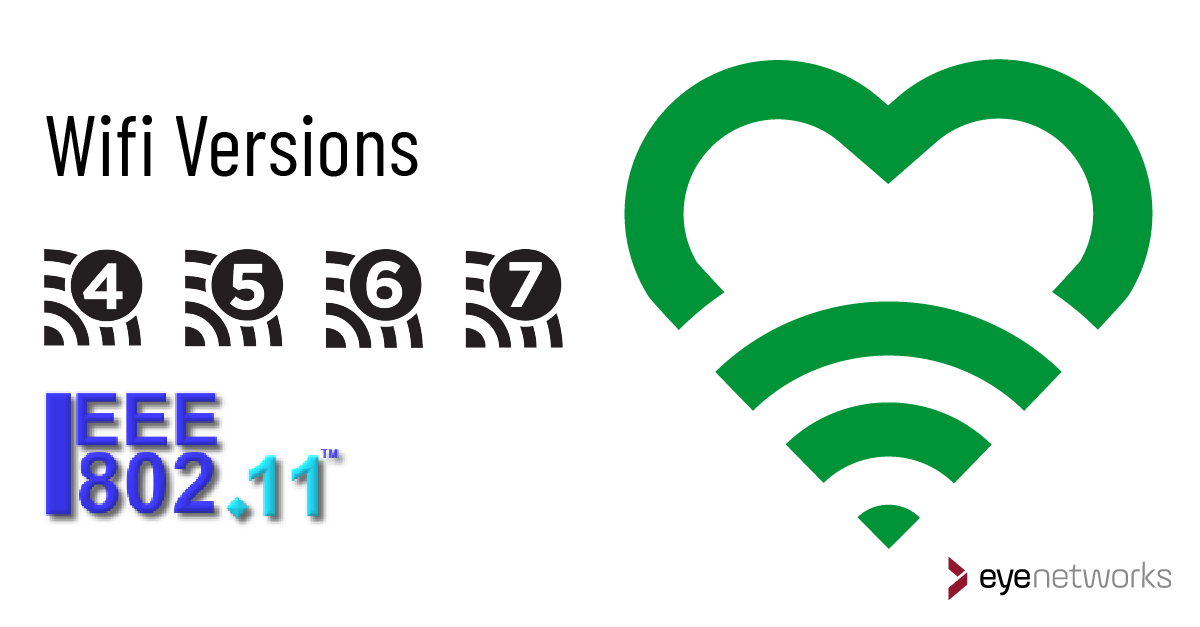
How many versions of the wifi standard actually exist? Why do some say “Wi-Fi 7” and others 802.11be? Get an overview of the wifi generations so far.
The standards for wireless communication that we colloquially call “wifi” are developed and maintained by IEEE 802, which is a group under the Institute of Electrical and Electronics Engineers. The standards from this group are therefore referred to as 802.11, with letters used for versioning.
This is a structured versioning system, but it does not provide the most readable and intuitive names for us users.
“Wi-Fi” is actually a brand name from the industry organization Wi-Fi Alliance, denoting all products confirmed to follow the 802.11 standards. In 2018, the Wi-Fi Alliance introduced a numbering system to be used on certified Wi-Fi products to more easily signal their performance capabilities.
The higher the number, the newer the technology and the higher the possible speeds. “Wi-Fi 7” is understood as 7th generation wifi, while “Wi-Fi 4” was the 4th generation. The first three generations are considered so outdated that they have not been named.
Generation names and standard names are now used interchangeably, and it is therefore not incorrect to use “ax” or “be” to describe what a product supports, although it is becoming increasingly common to refer to the generations.
| Standard | Also known as | Description |
|---|---|---|
| 802.11be | Wi-Fi 7 | The standard is also referred to as EHT — Extremely High Throughput. Performance and capacity are the primary focus. The very first products entered the market in 2023. Certification from the Wi-Fi Alliance began in January 2024, and finalization of the standard is expected during the year. Frequency bands: 2.4, 5, and 6 GHz Theoretical top speed: 46.1 Gbps Read more: Wi-Fi 7: What is it and who needs it? |
| 802.11ax | Wi-Fi 6 Wi-Fi 6E | Also called “high efficiency wireless,” the goal was to quadruple throughput compared to Wi-Fi 5 / 802.11ac. This is the latest standard in general use today. The Wi-Fi Alliance began certifying Wi-Fi 6 products in September 2019, and the standard itself was finally approved in May 2021. Frequency bands: 2.4, 5, and (for the first time) 6 GHz. Note that most Wi-Fi 6 products do not support 6 GHz. Wi-Fi 6E is a separate certification for 6 GHz-compatible products. Theoretical top speed: 9.6 Gbps Read more: Wi-Fi 6E: Internet on 6 GHz Wi-Fi 6: What can we expect from 802.11ax? Wi-Fi 6: Compatibility issues you should know about |
| 802.11ac | Wi-Fi 5 | In use since 2014. Focus on increased speed. The standard is backward compatible with 802.11n. Frequency bands: 5 GHz only Theoretical top speed: 6.9 Gbps. Read more: 802.11ac Wave 2: What’s new? |
| 802.11n or an | Wi-Fi 4 | In use since 2009. This version also introduced MIMO, Multiple Input Multiple Output data, where multiple antennas are used to streamline communication between transmitter and receiver without requiring higher bandwidth or more transmitter capacity. Frequency bands: The first version of the standard to include both 2.4 and 5 GHz. Theoretical top speed: 600 Mbps |
| 802.11g | – | In use since 2003 Frequency bands: Included only the 2.4 GHz band. Theoretical top speed: 54 Mbps |
| 802.11a and 802.11b | – | In use since 1999 Theoretical top speeds: 802.11a: 54 Mbps (5 GHz) 802.11b: 11 Mbps (2.4 GHz) |
You can read more about how wifi came to be and how it has evolved in The History of wifi.
See also:
- Remember to check which wifi standards are supported before buying new electronics
- Is your internet connection slow even though you have a new mobile or router that supports the latest standards?
Links
Wi-Fi Alliance on:
- Wi-Fi 7: https://www.wi-fi.org/discover-wi-fi/wi-fi-certified-7
- Wi-Fi 6: https://www.wi-fi.org/discover-wi-fi/wi-fi-certified-6
Article by Jorunn Danielsen