
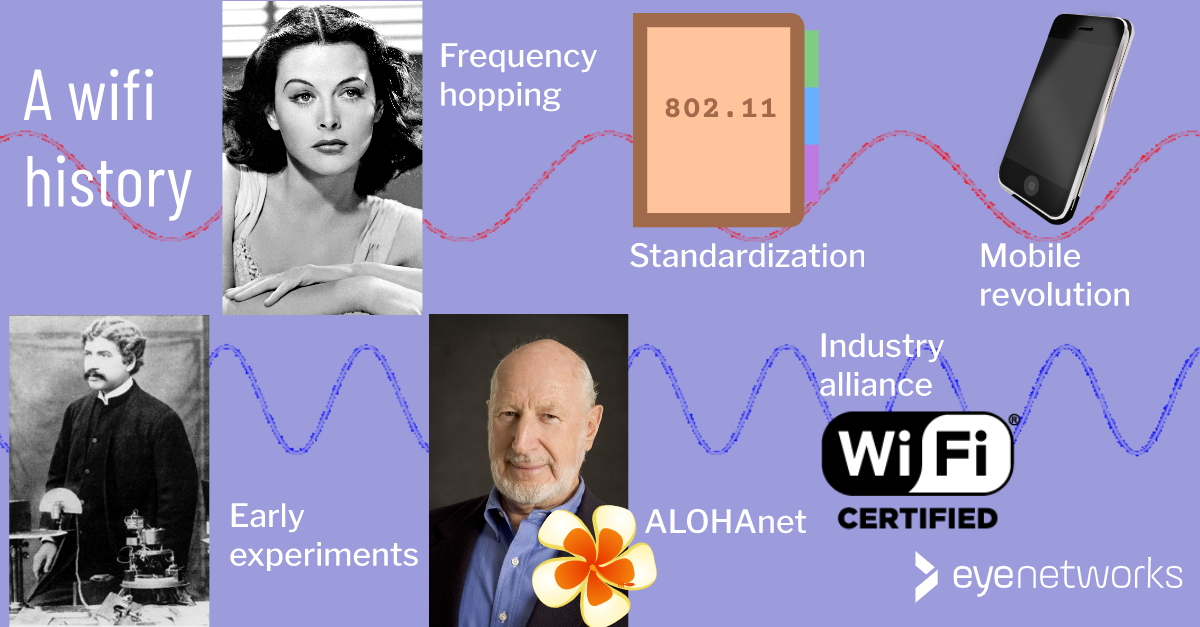
Wifi went from unknown to indispensable in 20 years. Where did wifi originate? Who do we have to thank for Netflix in the bathroom and Facebook on the patio?
The first communication networks were both wireless and pre-industrial: smoke signals, light and flame signals, mirrors, signal shots, and flags are all examples of technologies that have been used for the wireless transfer of information, starting long before the telegraph and the telephone brought wires into long-distance communication.
Hertz, Bose, and the Invisible Light
The radio became the first wireless technology of the industrial age. The first reliable, well-documented transmissions of electromagnetic waves were made by Heinrich Rudolf Hertz in the 1880s. The unit of measurement for oscillations per second has since been named after him.
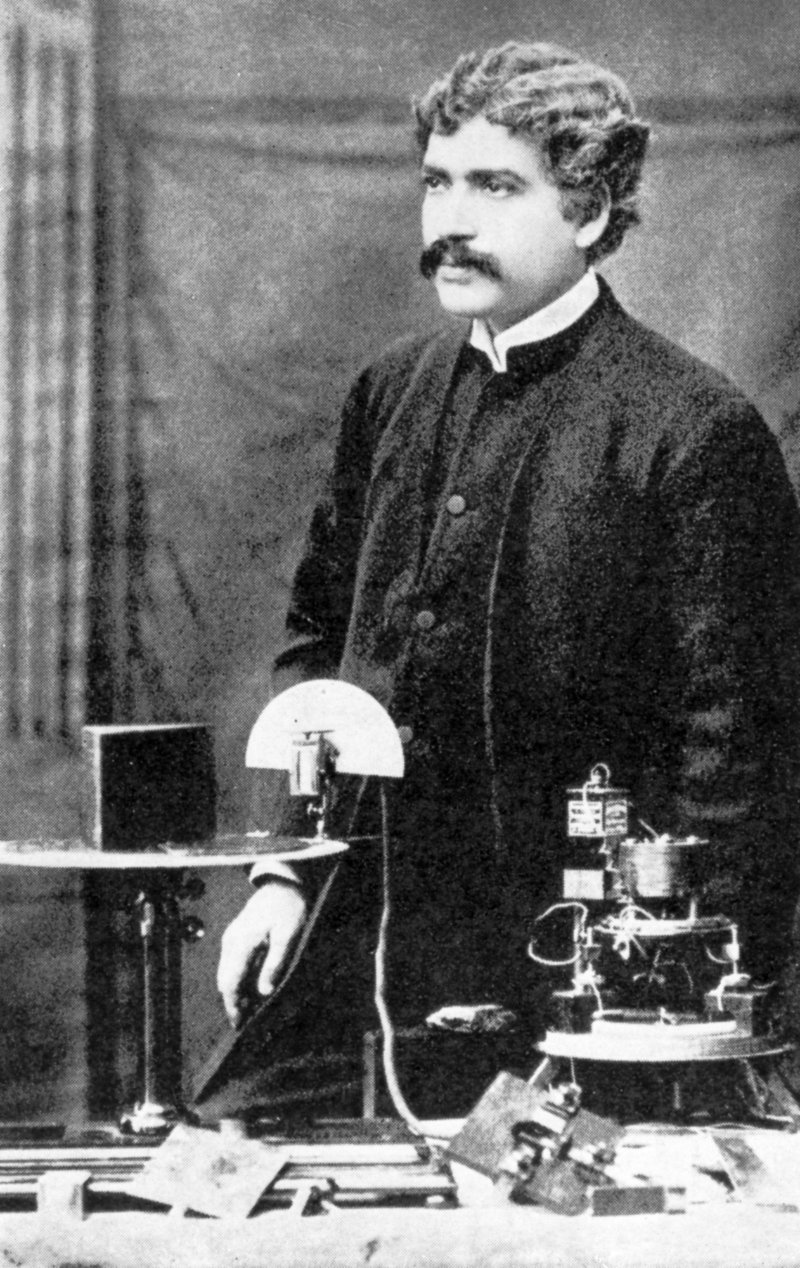
Serbian-American Nikola Tesla and Bengali Jagadish Chandra Bose were two of many scientists that continued the work Hertz had done with radio waves.
In the 1890s, Bose famously demonstrated microwaves by using them to ignite gunpowder and ring a bell at a distance, in front of an audience in the town hall of Kolkata.
In his essay “Invisible Light”, Bose wrote:
“The invisible light can easily pass through brick walls, buildings, etc. Therefore, messages can be transmitted using it without the mediation of wires.”
Towards the turn of the century, Guglielmo Marconi introduced the first commercially usable apparatus for wireless long-distance telegraphy–building on the work of, among others, Hertz, Tesla, and Bose.
Tesla’s Method
Nikola Tesla was also behind the first known method for changing frequencies to avoid interference. In 1903 he patented a system where the transmitter and the receiver switch synchronously between two channels.
Like all groundbreaking communications technology, the method soon found military application, first among the Germans, who from 1915 used radio with changing frequencies to prevent British eavesdropping.
Hedy, Bad Boy George, and the Torpedoes

The person who would further develop this technology was Hollywood star Hedy Lamarr, who was sharp and inventive and had what one might call versatile interests.
She developed her contribution to wifi history together with avant garde composer George Antheil, who liked to refer to himself as “the bad boy of music”.
Lamarr, who was familiar with radio engineering and weapons manufacturing, knew that torpedoes were effective weapons but vulnerable to detection and sabotage of radio signals. It was she who came up with the idea of using multiple, alternating frequencies to make the signals more difficult to sabotage, calling it frequency hopping—an early example of so-called spread spectrum technology.
The composer Antheil had experience with synchronizing self-playing pianos. The two took inspiration from this to develop a secret communication system for the remote control of torpedoes, based on a frequency hopping mechanism that switched between 88 different frequencies. In 1942, they received a patent for this system.
However, the American navy proved unenthusiastic about the proposed apparatus for making use of this system, and so did not adopt it at the time. Only much later, after the original patent had expired, someone finally put their invention to use for military purposes.
In 1997, the Electronic Frontier Foundation (EFF) awarded Lamarr and Antheil (posthumously) their Pioneer Award for the inventors’ “trail-blazing development of a technology that has become a key component of wireless data systems”.
Lamarr passed away in 2000. The animation below was made by Google for her 101st birthday in 2015:
ALOHAnet

Packet radio is a radio communication technology that sends data as packets. The first packet radio network was developed at the University of Hawaii in 1971. ALOHAnet connected seven campuses on four different islands, ensuring that they could all communicate with each other through a central computer located on the island of Oahu. The group that developed the network was headed by Professor Norman Abramson.
ALOHAnet also gained interest with the US military and DARPA (Defense Advanced Research Projects Agency), who came to develop multiple networks based on packet radio, for tactical field communication usage, among others. This was during the same time that DARPA was developing ARPANET, now known as the predecessor of the internet.
Packet radio networks gained some traction in the private market as well, but they were never a commercial success–transmission speeds were too low, costs were too high, and the availability was too limited. Today, amateur/HAM radios are the most common use for packet radio.
Many manufacturers opted for the cabled Ethernet technology, that was available from the early 80s, rather than the slow and expensive packet radio. Soon, completely new wireless possibilities would also open up.
Opening Up the Garbage Bands
In 1985, FCC, the US telecommunication authorities, chose to open up three frequency bands on the wireless spectrum for unlicensed use.
Those bands, also known as “the garbage bands”, were 900 MHz, 2.4 GHz, and 5.8 GHz.
These bands were already in use for, among other purposes, microwave ovens, that cook food using radio waves. The condition for using these bands for communication purposes, was therefore being able to work around interference from other equipment by using spread spectrum technology – like frequency hopping.
Vendors quickly started developing their own, proprietary solutions that communicated using these frequencies. While some of them worked just fine on their own, the obvious weakness was the lack of communication across solutions.
Enter Standardization
Vendors therefore slowly came to see the need for a shared wireless standard, much like Ethernet had become a successful industry standard for wired network communication.
A committee of the organization Institute of Electrical and Electronics Engineers (IEEE) develops the Ethernet standard, and so the vendors contacted IEEE to discuss the possibility of forming a brand new standards committee for wireless communications.
The new committee was formally established in 1990 and was given the catchy name 802.11 – which has since been a permanent part of the name of the wireless standards.
The committee finally agreed on and released the first, foundational standard in 1997. The first 802.11 standard used frequency hopping and provided a data transfer capacity of 2 megabit per second.
Over the next few years, new variants of the standard came along quite frequently, and frequency hopping was eventually replaced with another spread spectrum technology called direct sequence.
The Origin of “Wi-Fi”

Technical standards are comprehensive documents that are often interpreted differently when they are put into practice, and that happened here as well.
In 1999, six major vendors therefore founded a new industry alliance to improve cross compatibility.
The new alliance had a great cause, but they were in need of a good name, both for themselves and for the standards they were going to promote. They hired branding consultants to find a name that was “a little more catchy than ‘IEEE 802.11b Direct Sequence’”.
The consultants proposed “Wi-Fi” as a riff on “hi-fi”, borrowed from the world of music. And no, it wasn’t meant to be an abbreviation, “wifi” doesn’t actually stand for anything, although people have tried to use the term “wireless fidelity” for a while – without it catching on.
The term “Wi-Fi” itself, however, caught on quickly, and it stuck.
The new industry association became the Wi-Fi Alliance, and today hundreds of technology vendors are part of this alliance. The alliance promotes wireless technology, manages “Wi-Fi” as a quality seal and brand, and certifies wireless products.
When it comes to developing the standards, however, IEEE committee 802.11 is still in charge.
Portable Goes Wireless, and Wireless Takes Off
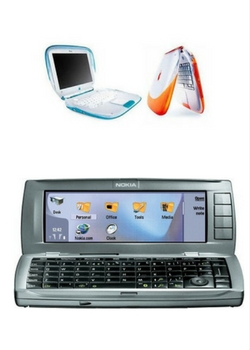
In 1999, Apple introduced the iBook G3, which became the first laptop with integrated wifi made for consumers. The iconic laptop had a characteristic shape and colors that prompted people to compare it to both Barbie accessories and toilet seats.
Laptop PCs with wifi soon followed, and the first mobile phones certified by the Wi-Fi Alliance were introduced in 2004. One of the earliest models was the Nokia 9500 Communicator. One of the earliest was Nokia’s 9500 Communicator.
Since the iBook, the number of connected gadgets has snowballed, and wifi has become the most common way of connecting.
In 2015, the 802.11 committee created a series of short YouTube videos to celebrate its 25th anniversary. In the film below, you can watch committee member Dave Bagby talk about how little interest there was in wireless networking when they started, and what he believes has been the most important success factor since:
We designed it for mobility.
Dave Bagby
What Next?
Today, almost everyone has at least one device that can send and receive data wirelessly–in fact, most of us have several.
In a Norwegian survey from 2016, 25% reported using five or more devices connected to the internet on a daily basis. 46% reported using three or four connected devices. Only 3% reported not having any devices connected to the internet.
The advent of smart home technology and the Internet of Things even has our homes and interiors using wifi on their own.
When a lot of devices are fighting for wireless capacity, wifi can quickly become a bottleneck.
Is this happening to you?
We recommend having a look at the tips and tools we have gathered here at Wifi Central.
More Sources / References
Most sources are linked directly in the article above, but information is also taken from:
June 1941: Hedy Lamarr and George Antheil submit patent for radio frequency hopping (American Physical Society News)
A Brief History of Wi-Fi (The Economist)
History of Wireless Communication (Seymour and Shaheen, Review of Business Information Systems)
Article by Jorunn Danielsen