
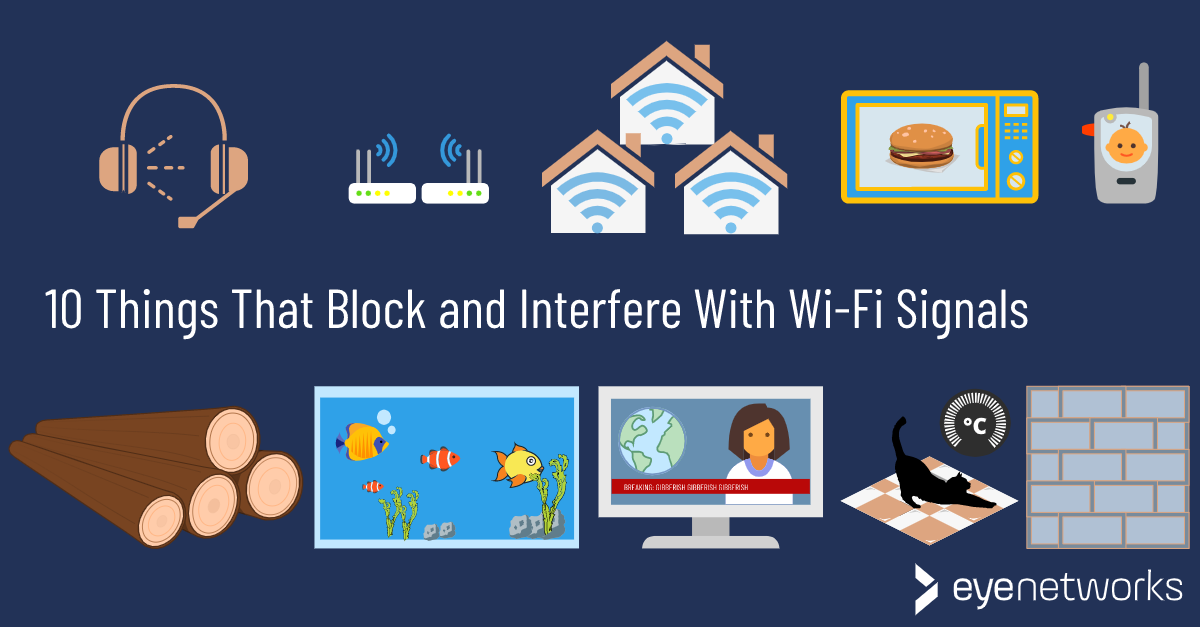
Anything from building materials such as steel and concrete to aquariums and electronics can get in the way of wifi signals in a home. This may lead to signal coverage issues.
Signal Disturbances and Interference
New equipment that supports the 5 GHz and possibly 6 GHz frequency band, produce wifi signals that have a shorter range and that are therefore less vulnerable to interference than older or more limited equipment that can only use the 2.4 GHz band.
See also+: 5 GHz – din beste wifi-venn.
1. Your Neighbor’s Network

When many networks are located closely together, such as in housing associations, this will affect wireless capacity. For equipment on the 2.4 GHz band, neighboring networks are the largest source of noise on the wireless network.
See also:
- Derfor får du bedre wifi med båndstyring
- Locating Good wifi Channels and Bad Neighbors with a wifi Scanner
2. Separate Wireless Networks in Your Own Home
If you have multiple wireless networks at home that are set up on different equipment – this can be even more disruptive than your neighbor’s network. If you need to log in to wifi with different access levels, we recommend setting up a guest network with its own network name (SSID) on the same router or access point as the primary network.
3. Bluetooth
Wireless devices such as headsets, keyboards, and mice can interfere with the Wi-Fi signals. Bluetooth uses a technology called frequency hopping, which means it hops around the 2.4 GHz band, up to 1600 times per second(!)
When equipment that uses Bluetooth jumps into the frequency range of equipment that uses wifi, it can disrupt wifi traffic and cause delays. As it jumps so often, actual impact on wifi will be highly variable, making such scenarios rather hard to troubleshoot.
In the worst case, your wifi access point will automatically change channels to avoid the noise – a failed strategy, since Bluetooth hops over all the channels used for wifi anyway, which in turn can cause you to lose more wifi traffic. Old devices and computers in particular will need several seconds to reconnect if the access point changes to a different channel.
4. Baby Monitors, Walkie-Talkies and Other Radios
Do you have baby monitors, walkie talkies, or maybe a radio locator to keep track of your pets or keys? Such equipment usually runs on the same frequency as the older wifi standards 802.11b/g/n and will thus interfere with the 2.4 GHz band.
Traditionally, this type of equipment does not use wifi and makes use of the entire frequency band without any regard to other communication on the same frequency.
5. Microwave Oven
Microwave ovens use electromagnetic waves at 2.4 GHz to heat food. Unfortunately, the older wifi standards, 802.11 b, g and n also use electromagnetic waves at 2.4 GHz, but with much weaker transmission power.
Although all microwave ovens are well covered, there will always be some degree of “leakage” of waves – a slight leak is not dangerous to humans, but:
- Most microwave ovens are at about 1000 W.
- Most wifi access points can transmit a maximum of 0.1 W.
It therefore doesn’t take much leakage before the 2.4 GHz band in the area becomes unusable.
Physical Obstacles to Wifi Signals
Because equipment using the 5 GHz band has a shorter range, it is also more dependent on a clear line of sight between the router/wireless access point and the clients connecting to it.
Some obstacles can be removed or the access point moved away from them, while it is more difficult to do anything about building materials in the home that block signals.
The solution we recommend to ensure coverage in such cases is a network of multiple wireless access points; a mesh network. See also All about mesh wifi.
6. Concrete and Masonry Walls
Different building materials block wifi signals to very different degrees. Wifi signals are most weakened by having to go through thick walls, especially reinforced concrete.
See also: Wifi Signal Loss By Building Material.
7. Thick Timber Walls
Regular wooden walls do cause some signal loss, but not much. However, timber walls have are a significant obstacle to wifi signals. You can read more about this in Wifi Signal Loss By Building Material.
8. Metal and Floor Heating
When signals need to travel across multiple floors, underfloor heating cables can create problems for wireless signals.
And is your router or other wireless access point placed inside a metal cabinet? Get it out in the open if you can!
9. Water
Do you use hydronics for heating in your home? Or do you have a really big aquarium? Here the signals also struggle to penetrate.
10. The TV
Perhaps the most common cause of weakened wifi signals–– don’t place your router or any other wireless access points behind the TV!
Article by Geir Arne Rimala and Jorunn Danielsen