
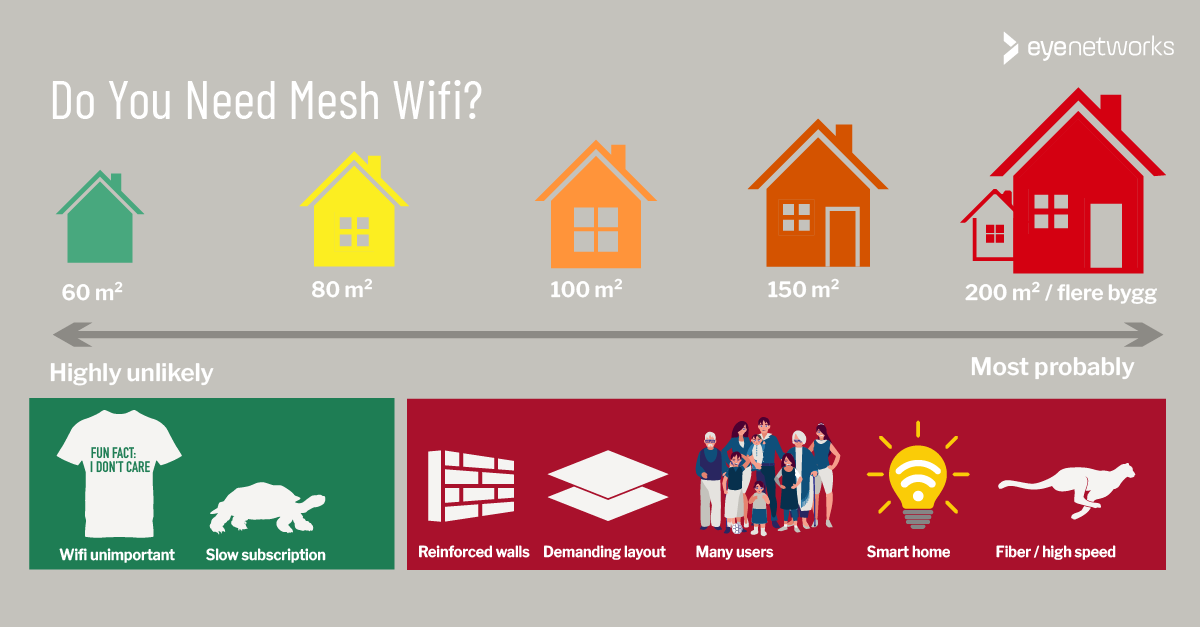
Should you get a mesh network for your home, or can you get by with a single router for wifi? That depends on the home, but also on the people who live there.
1. Are You Currently Having Problems With Wifi Coverage Or Capacity?
There are differences between wifi devices, and not least between old and new wifi standards, but all devices are bound by the laws of physics — and by national rules for permitted transmission power.
If you already have problems with dead zones/weak coverage in your home, it is unlikely that you can solve this by replacing one router with another.
Wifi as a bottleneck can also manifest itself in the form of problems with streaming services “buffering”, dropping out of video meetings, or the network feeling slow — even with a fast broadband subscription. In that case, you probably need more wifi capacity.
Mesh networks expand coverage and increase capacity at the same time.
2. How Big Is Your Home?
Size is important when it comes to mesh needs, but it’s not the only deciding factor. Basically, the larger your home, the more likely you are to need mesh wifi, regardless of the answers to the other questions.
- If your home is 60 square meters or less, you will most likely be able to get by with a router.
- If you are having problems with wifi in a home this size, the problem may be the quality of the router.
- Homes that are over 150 square meters and/or span multiple buildings will never get adequate wifi with a single router.
3. What Kinds Of Building Materials And Layout Does The Home Have?
Heavy building materials and large physical obstacles limit the range of wifi signals. Light materials let signals through–even from your neighbor.
- Lots of reinforcement, water-based heating, metal bathrooms, brick fireplaces: You’ll likely need mesh to get coverage everywhere you want it. Expect signals to come through a maximum of 2 reinforced walls and 1 floor in each direction.
- Mainly wooden and/or light walls: Signals will reach further, and you may be able to do without mesh, or with fewer nodes.
- Wooden inter-floor structure: Typical for old apartment buildings, for example. Here you may have a bigger problem with wireless interference from your neighbors’ networks.
4. How Many People Use The Internet At The Same Time?
Not only family members and guests, but also smart devices must be considered here.
- The usage patterns of older children can be just as conducive to mesh needs as having a large home!
- It does not affect coverage, but is highly relevant to the available capacity.
- Door and window sensors, cameras, doorbells, and smart light bulbs usually use wifi and are always connected.
- Many of them are also placed on the outer edges of the home, where coverage is often the poorest.
- Such devices rarely transfer a lot of data, but they rely on a stable connection to function properly. Smart homes almost always need mesh.
5. How Important Is Having Good Wifi Everywhere In Your Home To You?
With the answers to the questions above in mind, you hopefully have an answer ready for this.
- Good wifi throughout the home is important to you: A mesh wifi network is probably a good solution, even if your home is not all that large.
- You only need wifi in certain locations: You need to decide whether these locations are adequately covered by the router, or whether you might need a mesh network to cover parts of your home.
If you have decided that you need mesh, the next question will often be: How many mesh nodes do you need?
This guide is part of the All About Mesh series:
- What Is Mesh Wifi?
- Do You Need Mesh Wifi At Home?
- How Many Mesh Nodes Do You Need?
- How To Place Mesh Nodes For Optimal Wifi
- Mesh Wifi Issues: Tweaks And Troubleshooting